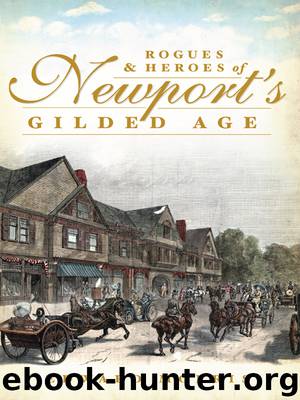
Rogues and Heroes of Newport's Gilded Age by Edward Morris
Author:Edward Morris
Language: eng
Format: epub
Publisher: Arcadia Publishing Inc.
Published: 2012-03-13T16:00:00+00:00
STANFORD WHITE
“Voluptuary and Pervert—Dies the Death of a Dog!” Said Vanity Fair in 1906
In 1853, Newport real estate developer Alfred Smith completed the fifty-foot-wide Bellevue Avenue, and sixty new houses were built here. This was also the year that the New York City Council approved the creation of Central Park and the Crystal Palace Exposition opened in New York’s Bryant Park behind what is now the New York Public Library at Forty-second Street and Fifth Avenue.
And coincidentally, architect Stanford White was born on November 9, 1853, on East Tenth Street, near St. Mark’s Church on Bowery, where there were fifty-two taverns and twenty-seven oyster houses. Could that possibly explain why “Holy Moses, gin and seltzer!” was Stanford White’s favorite expression? Also, coincidentally, 1853 was the year the New York Central Railroad was established from a union of twelve small lines.
White’s father, Richard Grant White, had a six-hundred-volume library of Shakespeare’s poetry. He worked as a reporter for the New York Courier and Enquirer and alternately for the New York Customhouse because his too strongly expressed views about political corruption in New York kept making him change jobs.
“Stanny” was the youngest of Richard White’s two sons and at age sixteen had a strong talent and desire to be an artist. But two of his father’s close friends, John LaFarge and Frederick Law Olmsted, recommended architecture as more remunerative.
Olmsted took Stanny to the New York office of Henry Hobson Richardson, the second American architect to have studied at the École des Beaux Arts in Paris (after Richard Hunt). Richardson hired Stanny on the spot. And Richardson’s office manager was Charles McKim, the third American architect to have studied at the École and an excellent teacher for young quick-learning Stanny.
Richardson was jolly, liked to drink with his staff and clients and, like Richard Hunt, said, “I’ll plan anything a man wants, from a cathedral to a chicken coop. That’s the way I make my living!”
Richardson’s technique was to provide a rough sketch of a project to his draftsmen and make numerous suggestions as the project developed so in the end the final design was his own. But his staff had learned to “think for themselves.”
The first house to which White contributed work in Richardson’s office was a large summer cottage overlooking the water in Middletown, Rhode Island, for Frank Williams Andrews in 1872 and 1873. It was inspired by English architect Richard Norman Shaw’s first Queen Anne–style house built in 1868 in England, with multiple gables and small-paned windows, but here a variety of shingle patterns was added to further break up the wall spaces.
Also in 1872, Richardson’s office won the commission to build Boston’s Trinity Church, and McKim’s designs were turned over to eighteen-year-old Stanny when McKim resigned to set up his own office in New York. Then White redesigned the church tower.
White also contributed to Richardson’s design of wealthy banker William Watts Sherman’s Queen Anne–style mansion on Newport’s Shepard Avenue, opposite Chateau Sur Mer, between 1874 and 1876.
Sherman had married George
Download
This site does not store any files on its server. We only index and link to content provided by other sites. Please contact the content providers to delete copyright contents if any and email us, we'll remove relevant links or contents immediately.
Fanny Burney by Claire Harman(26602)
Empire of the Sikhs by Patwant Singh(23084)
Out of India by Michael Foss(16853)
Leonardo da Vinci by Walter Isaacson(13336)
Small Great Things by Jodi Picoult(7140)
The Six Wives Of Henry VIII (WOMEN IN HISTORY) by Fraser Antonia(5515)
The Wind in My Hair by Masih Alinejad(5095)
A Higher Loyalty: Truth, Lies, and Leadership by James Comey(4960)
The Crown by Robert Lacey(4814)
The Lonely City by Olivia Laing(4801)
Millionaire: The Philanderer, Gambler, and Duelist Who Invented Modern Finance by Janet Gleeson(4478)
The Iron Duke by The Iron Duke(4354)
Papillon (English) by Henri Charrière(4274)
Sticky Fingers by Joe Hagan(4198)
Joan of Arc by Mary Gordon(4109)
Alive: The Story of the Andes Survivors by Piers Paul Read(4031)
Stalin by Stephen Kotkin(3965)
Aleister Crowley: The Biography by Tobias Churton(3640)
Ants Among Elephants by Sujatha Gidla(3467)
